Virtual Reality in Travel and Tourism
Virtual reality is a new, see-through-the-lens technology that can introduce you into a convincing virtual world on the spot. It is deeply immersive with interactive 3D content that allows for many uses and possibilities. To the online market, this sounds almost like the long-awaited savior. But, virtual reality has some history, and it hasn’t begun its journey just a year ago. Moving from one industry to the other, Virtual Reality has achieved an ever better graphics quality and hardware power, including body-tracking, smoother experience, and newer techs that add more to the overall immersion level. The travel and tourism industry is one of these domains, and it’s likely to be completely shaped by virtual reality as this technology becomes the bedrock of how travel agencies and hotels will connect with their customers. So, how much of the travel industry will change? And how will virtual reality in tourism affect our adventurous experiences?
Below we will outline some of the ways and breakthroughs VR will have on this specific – but so exciting – industry.
Table of Contents
Virtual Reality in Travel
The travel industry has already become a marked territory for VR from several years back. When the concept of VR in association to travel was only just a theory, some startups and large companies across the world managed to pave the way for a mainstream VR by creating impressive, travel-related virtual experiences. In 2018 in Paris, a French startup introduced incoming tourists to a fascinating VR experience in which they flew over the sky of Paris in a jetpack. While completely new to many of these foreign tourists, this fascinating flying VR app should certainly have left these travel enthusiasts thinking about the headsets as a newer way to experience tourism. (1)
But, this type of VR usage is just one of the various ways to improve the industry. Think about the marketing aspect, the booking process, and visual demonstrations that travel agencies, airlines, hotels, and others use to show you what you will get out of your travel journey. With VR within the travel industry, they no longer have to issue 2D pictures or paper booklets to your end – which are poor and unsatisfying in terms of presentation. Rather, they will offer you a rich, virtual 3D environment with photo-realistic persons passing by in Venice, for example, to let you truly have a “try-before-you-buy” experience and make smarter decisions. And while you are there in VR, why not walk closer to the water canals of Venice? maybe also inspect the stores and pick up a virtually-reconstructed apple with your VR controllers? All of this is doable right now, and VR has even more for travel and tourism.
Benefits of Virtual Reality in Travel and Tourism
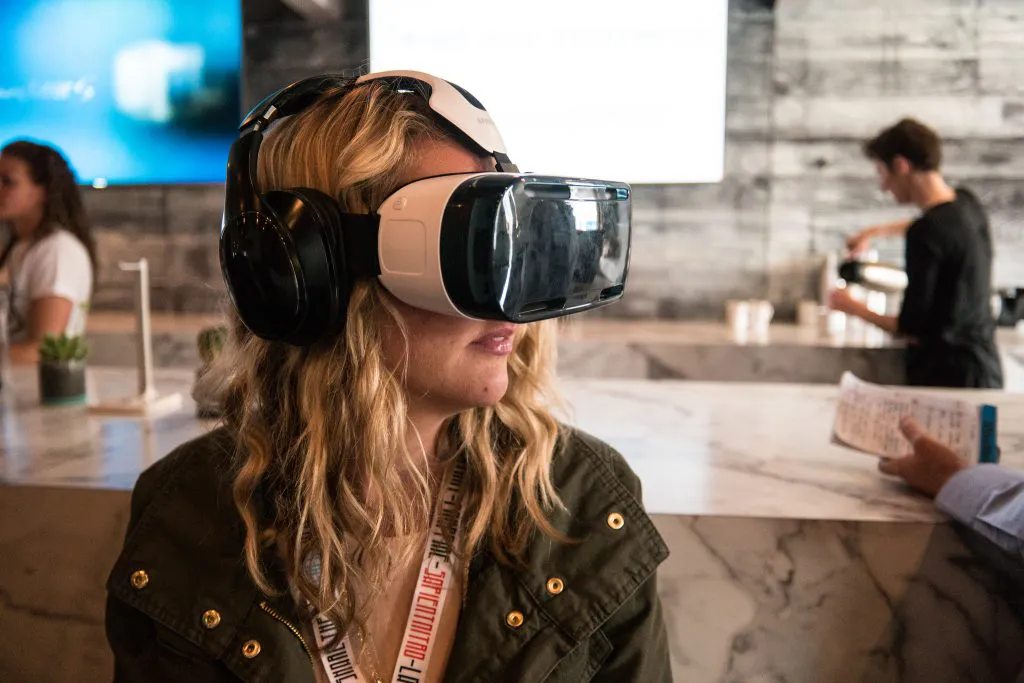
Photo source: Flickr Nan Palmero
The virtual experience brings with it a long list of benefits that will have a snowball effect for travel as VR continues to improve. In one way, Virtual Reality is one of the unique technologies that protect the ecosystem rather than harm it. Traditional ways of receiving visitors result in crowds who overburden your touristic destinations or endanger sensitive touristic ecosystems. As the owner of the destination, your job is to avoid this hassle by satisfying customers with an experience most closest to reality, and a VR-created environment does that with style.
Likewise, travel agents benefit from VR-created environments when the user’s satisfaction and authentic experience make the process transparent. You don’t need any testimonies or large investments on traditional media. Your marketing plans just need the immersive power of virtual reality programming.
VR in the travel industry also helps specific brands stand out from the rest. VR’s success, like any other outlet, depends on the quality and creativity of the experience. Designing the right things in VR and investing in its quality will guarantee the best customer engagement. This fact has always translated into revenue.
Lastly, virtual reality is a life-saver for people who can’t reach tourist destinations. Whether they live too far away or don’t have the finances to travel, these people can put on a headset and teleport to their favorite locations anytime they want.
VR for Hotels
How many times have you picked a hotel but the experience ended up disappointing or just different from what you imagined? This is a common issue, especially when we choose our hotels based on standard images or while we are in a hurry. Fortunately, it will not be too long before a virtual stroll through corridors and rooms of a hotel are the new normal. Your window looking out on the beach will be as romantic as you wish it to be, and there will be no more equipment malfunction or lack of cleanliness. Though the tech is not everywhere yet, these hotel tours are already being offered in major world places like New York, Paris, London, Japan, and Prague. You can jump on these opportunities if you want by loading their websites and checking their VR demos or 360-degree videos. You might forget yourself for long periods when exploring their grounds as touristic virtual reality feels as good as being there.
Booking in VR
The booking process in virtual reality is equally enjoyable to the VR experience itself. We are all familiar with filtering through the endless prices and poring over the slides on a website. After a few minutes, it gets tedious. That’s why Virtual Reality is the better option since it includes a booking interface completely based in VR. With only a headset, you can now seamlessly swipe through the rooms, take in the beautiful outside environment, and notice the prices and key facts about the place, all within an animated virtual space and engaging 3D interfaces.
VR for Travel Experiences
Distinct from virtual tours and booking experiences is the joy of trying out virtual reality travel experiences. The magic of these apps and separate demos lies in how they transform indifferent customers into travel maniacs. The secret sauce is that virtual adventures and demos are so realistic and thrilling that they nurture your passion for those types of experiences. To illustrate, an app called Everest Virtual Reality Technology is created to put the user into the action and thrill of the climbing mount, Everest. Imagine making your way up through the thick snow of the mountain. The icy winds are blowing hard at your face while you are trying to keep your legs steady on a metallic ladder leading to the other side of the mount. This level of immersion can give you shivers.
In another app, you can flatter your artistic profile by visiting a virtual reality museum. You can come as close as you can to the paintings, and touch the intriguing sculptures of your liking.
Over time, this will be the ultimate strategy of VR in travel to bring people closer to endless touristic locations.
VR in University Campus
With this lockdown of COVID 19, it has become so much more urgent to make use of Virtual Reality for accessing places that are important for people. One good example is visiting your university or school campus before the start of the year. It may sound too good to be true at first, but the 3D content and 360-degree videos are being created by many technology companies. The quality of immersion is photo-realistic and fully-detailed, allowing you to experience your future school with most of your senses and then discover the ins and outs of the buildings and different school sections.
Where Will VR in Travel Go from Here?
Despite the excitement and waves of businesses and agencies trying to adopt Virtual Reality, the technology is far from its fullest potential and highest performance. There are a lot of VR manufacturers who are working hard to push this trend even further, and as such, we will see major updates in the upcoming years that will largely benefit VR in the travel and tourism industry. In many studies conducted by Statista, it has been demonstrated that 70% of the American respondents participating in the study preferred travel as the main industry for virtual reality. (2) This shows that most users also see the potential of VR in completely transforming the travel industry very soon. Nonetheless, as good as VR can be, most users doubt that VR will ever replace real-life travel. What’s certain, though, is that our headsets will be indispensable in the future and they surely will accompany us everywhere, even in our travel escapades.
VR’s take on medical education
Gaming. That’s what VR is all about, just a toy to escape into other worlds right? While VR might have its roots in the gaming industry, it advanced itself into saving lives by educating future doctors. Sheer endless possibilities occur with the digital revolution, vast virtual worlds can be explored so why not use that power to create digital representations of the human body? Layer by layer, fiber by fiber, muscle by muscle. Understanding human anatomy has never been more efficient and engaging!
Table of Contents
“It’s like putting a puzzle together”
Grasping the complexity of human anatomy can be though. The digital century is taking over the world, yet medical education seems old-fashioned. There’s great knowledge in books, knowledge that’s limited to 2D visualizations. “Our instructors do an amazing job, but at the same time, it is difficult to get an entire three-dimensional picture of what is going on”, so Jordan Holler, medical student at UC San Francisco.
Normally education in human anatomy uses two sources of information, books and cadavers. Yet it’s sure enough great to deal with real human bodies, they offer a limited amount of things to explore and once a cut is made, there’s no going back.
Touring the body with the usage of VR tackles that exact problem by offering medical students a tool to de- and reconstruct any human body to a molecular level in endless different scenarios and amounts of times.
Removing tissues, adding them back to where they belong, grabbing individual fibers, and analyze them three-dimensionally in real size is just something unique that can’t be recreated with old-fashioned, analog medical education methods.
Combination is key
Digital education offers an endless amount of new possibilities, but why don’t combine the best sides of two worlds?
In a normal environment, medical students use models and cadavers to try various types of surgeries. Virtual reality can of course offer an endless amount of different surgical scenarios, yet there’s one thing students are missing out when using VR: Haptic feedback. That’s where a total virtual experience transforms itself into an augmented reality one by using a combination of models/cadavers and 3d virtual tour service. Real tissue models can be prepared and used as a working base for VR created surgical scenarios. It seems futuristic, but by using this type of combination medical students can simulate and go through endless different types of surgeries without depending on the availability of cadavers.
This does not only improve the experience level of the upcoming doctors, it’s furthermore preparing them on a psychological level as well. Freshman doctors often struggle when they finally can prove themselves on real surgeries, it’s just not something they’re used to, furthermore, nervosity arises, the pressure of failure is unbelievable high causing fatal errors. A virtual medical education combined with old fashioned methods builds experience and confidence in our future lifesavers, by having already simulated almost every possible surgery.
Anatomy is not where the journey ends
As mentioned, psychological preparation is equally important as learning the skills themselves. This begins by simulating specific surgeries, preparing upcoming surgeons on the high pressure arising while saving lives. But preparation doesn’t have to stop there.
Not only the surgery itself but also the doctor’s surroundings have great impacts on how medical care will be performed. With analog educational methods, there has never been the possibility to actually prepare students for upcoming dangerous, non-standard environments. Imagine yourself being a freshman surgeon, motivated to save lives and make the world a little better, your first day arises and you’ll be called to execute an emergency surgery, not in the hospital, on the highway. The bodies are not perfectly prepared, you’re surrounded by sirens, officers and not to forget a lot of driving vehicles. Even though the surgery might be easy to execute, the surroundings are going to drive you crazy if you’re not used to such a specific situation.
The good news is VR is not limited to any standards. You can execute surgeries on the highway, inside a burning house, or even upon the ISS, there are just no limitations. Doctors can be prepared for almost every possible scenario and environment.
So, let’s get “wowed”
There’s an unbelievable beauty in the human body, exploring its particularities is something special and exciting. Yet touring the human body in 3D is not only educating medical students, but it’s also wowing them. The sheer complexity and beauty of every single fiber observed three-dimensional creates enthusiasm and the willingness to question and learn even more about the subtleties of our temple.
Virtual touring has come to a point where it’s not only informing people about buildings and possible getaways. It saves lives now, without extinguishing analog and old fashioned education.
Even though no one should ever experience difficult surgeries, we proudly can calm you down. The surgeon has already done it probably hundreds of times. That’s the power of digitization, that’s the power of VR, that’s what we call future
Download free ebook on real estate
Get the free e-book
The Top Trends in Cybersecurity e-book is a top-level report designed to deliver 10 trends and stats that matter most to security and enterprise leaders. It’s based on the 190-page Security Intelligence Report, researched by Microsoft experts over the past 10 years.
It’s imperative to stay on top of security concerns in today’s changing world. Read the e-Book to learn where liabilities hide, and how to prevent them.
Chapters include:
- Severity of vulnerabilities
- Most commonly detected objects
- Continued complexity of threads
- How Java exploits are on the decline
- A global snapshot of vulnerability hotbeds
How Virtual Reality in Higher Education Benefits Engineering and Science Students
Since the beginning of time, we as humans have attempted to create visual-based methods to help us remember certain information that otherwise would just float out of our heads.
This dates back to early cave drawings, and we have it now in the form of video content.
Virtual Reality is the next step in this evolution, as recent research has shown that people can recall information better through virtual reality and as such, can apply it better in the real world.
After all, experiencing is much more dramatic than just reading, as you can see the events evolve around your body in the virtual world. At the University of Maryland, researchers analyzed to find out if people learn better through immersive virtual environments when compared to more traditional methods of learning such as learning from a phone, tablet, or laptop. To successfully conduct this research, they recruited 40 volunteers who were unfamiliar with the world of virtual reality and they split these people into two groups.
The first group of people viewed information through a Virtual Reality headset first, and then on a desktop computer.
The second group viewed information through a desktop computer first, and then through a Virtual Reality headset.
The result was astonishing with an 8.8% improvement in recall accuracy for the group of people who experienced the Virtual Reality headset method first. This leads us to the conclusion that virtual reality is not only a great way to recall information more effectively, but it can even build empathy which helps people understand situations better by experiencing them virtually.
This is why it is only logical for educators and organizations to implement Virtual reality in higher education to transfer a higher level of knowledge onto their students more efficiently. On an almost daily basis, virtual reality is being adopted throughout education in different ways, and today we will be exploring what kind of impact it has on Engineering and Science students.
Table of Contents
Exploring VR in Education for Engineering
Virtual reality education is nothing new, but going forward, many new features are unlocked which will surely put engineering students at ease and give them a leg up.
According to vrs.org.uk, virtual reality in engineering can be implemented in:
· The Design Cycle
· The Virtual Construction Cycle
By using the latest VR technologies, students can build prototypes and help them to become visualized in real space, and gain information about the parameters related directly with real-world examples. To study specific parts of a product, and get a grasp of how it all works, with deeper understanding in its operation and the little details that make it, literally, tick, students might opt-in to develop prototypes. With the real-world creation of such prototype, which earlier involved the acquisition of materials, space to build the prototypes much easier with VR technologies so multiple variations of each of these prototypes can created to get the best possible learning experience.
These students can then have ability to interact with their prototypes, and make changes to their designs from the very inside of the model, something they might have missed while drawing it up on a 2D canvas for example. Through this, they can get a deeper understanding of exactly how the thing or in this case product works and improve the design altogether, in the end becoming even better engineers and developing something truly innovative.
Another logical benefit of implementing their designs into virtual reality instead of creating them into the real world is the cost of products. Some materials that the students might need to develop their prototype in the real world might be rare, expensive, or simply unconventional to acquire. In the case of virtual reality, they can simply recreate the physics and function behind the specific item they need in 3D and place it on their prototype at basically no cost at all. Once the specific model is created in 3D, it can be analyzed and specific parts can be analyzed and rectified on time before the model is approved to be created in the real world, assuming someone invests in the idea to become a reality.
In 2013, Ford Motor Co. used its immersive vehicle laboratory to go over 135.000 details on its 193 vehicle prototypes without building a physical version of any of the vehicles within a single year.
Viatechnik has made an amazing list of virtual technologies in architecture and engineering that show how this technology has been implemented for real-world projects so far.
Virtual Reality in Higher Education — Exploring Science
Dissecting a cell in virtual reality is possible, as the scientist can dissect it layer by layer, excavating it to uncover tiny structures buried beneath its surface.
Phys.org highlights how the Cell 101 VR App can show students a virtual reality perspective of the inner workings of cells and their interactions, which in turn allows them to visualize the cell biology.
Through a virtual reality environment, a student can visualize computer tomography scans from any patient and identify possible tumors that might arise, saving them in the process. Researches have proven that a 3D virtual environment allows radiologists to better visualize and identify potential tumors than with the standard 2D imaging methods that are available. By analyzing all of the data in three dimensions, you might find things and shift your perspective to a point that you otherwise would not have just by reviewing two-dimensional slices of tissues.
If a student had a task to analyze data that was already pre-constructed by a professor or is a direct dump of data from real-world scenarios, the student can simply walk around a 3D space while wearing the headset, and by using haptic gloves or controllers he can create a road-map of sorts as to how to resolve that issue. This is what makes Virtual reality in education an excellent way for students to memorize information more effectively and in turn would allow the scientist to develop a device that could resolve the issue, and construct it as a virtual reality prototype.
Then, when you bring in programming and machine learning into the picture, otherwise known as artificial intelligence, you can simulate how a real body works, how it reacts to certain things, and the prototype can be pushed in the virtual patient to see the potential outcome and results that can be expected before implementing it into a real patient. This will not only give students a bigger and better perspective as well as an understanding of how everything works but a chance to truly bring their ideas to life and potentially save millions of lives in the process.
Virtual Reality has its place in Higher Education and can benefit both Engineers and Scientists in ways that will move humanity forward as a whole. Their unique, quirky, and at times risky ideas can be tested out in a safe environment before being brought into the real world, effectively ruling out the good ones from the bad ones. As such, they can bring to the real market devices and tools that will change the way we do things, both in terms of technological advancements, and psychological thinking.
Virtual reality will truly shape and shift the minds of young students as it will open up an entirely new world to them, unlike anything we have experienced so far, and with all of that under the palm of their hands, who knows what they might bring to the real world.
Virtual Reality for New Construction Projects
Your experience of VR or brush with virtual reality, by and large, is limited to gaming like most other individuals. VR technology, which can simulate and augment a real environment or setting, initially found extensive applications in the gaming industry. However, VR has evolved and developed hugely over the years so much so that the technology is now being extensively used in several industries.
Of all the commercial or industrial segments that are increasingly exploiting virtual reality, the construction sector is one industry that stands out. VR can transform 2D and 3D designs and drawings into interactive and dynamic ones, thanks to standalone features like surround sound and haptic feedback. No wonder the construction industry is adopting VR along with AR (augmented reality) and MR (mixed reality) for improved safety, better design and client satisfaction, and, most importantly, monetary savings.
Several studies and surveys conducted on VR in the recent past have pointed out that architects, interior designers, and construction industry professionals consider the technology to be the most crucial budding technology.
Table of Contents
How Can VR Benefit The Construction Sector?
The gradually increasing application of VR in the construction industry spells numerous benefits for the latter. One bright and straightforward advantage is the creation of more efficient and accurate designs. Until architects started tapping VR, they had to rely on 2D and 3D models of building projects that often did not seem realistic to clients.
Additionally, architects and interior designers had a hard time convincing potential customers that the projects, once complete, would look exactly like the blueprints. Moreover, hitherto once construction of a structure started, effecting changes suggested by clients used to be very time consuming and expensive.
And this is precisely where virtual reality comes into play. The technology can be instrumental in helping spot problems, get rid of errors, and fine-tune the concept or design before the blueprint is approved. Consequently, construction companies and builders can keep a rein in cost overruns by ensuring that the proposal is perfect in all respects for execution.
Additionally, contractors and builders feel confident that they’ll be able to complete the project without overshooting the deadline, thanks to the perfectness of the plan. VR can also go a long way in facilitating realtors and real estate agents to promote a project under construction.
Reinforcing a 3D building project with VR enables prospective clients to undertake a virtual walk-through, resulting in better customer experience.
A VR-enabled design allows the potential end-user to take a virtual tour of the project right in his home or office. The prospective client is spared the trouble of visiting the upcoming project in person, thus saving him both time and money, mainly if the site is remotely located. Last but not least, a VR-oriented construction model makes it easier for the client to make an informed purchase decision.
VR can benefit every stakeholder involved in a new construction project in the following ways:-
Promotion of New Construction Projects
A building plan or project may appear perfect and accurate to the professional who has conceptualized it. Nevertheless, the problem arises when the architect or the promoter needs to market the proposal to future clients. 2D or 3D design renderings may not appear realistic and practical to customers as they may not be well-versed in architectural concepts.
However, VR technology enables clients to observe the project almost in the same way they’d have surveyed the site in person. Currently, designers and architects have access to various VR design software applications and packages that help in creating projects that will allow potential customers to take a virtual tour. As an architect or urban planner, if you’re not very conversant with digital design software, VR design apps can appear somewhat intimidating initially.
However, once you become acquainted with the hardware and software associated with VR design, you’ll be reaping huge benefits. You’ll be able to showcase your project to your clients in a manner where they’ll see everything precisely in the way you want them to notice. Once you become adept at developing a plan using the VR design app, you’ll never again have to struggle to convince your clients about the practicality of your design concepts.
You and every other professional engaged with the project will find it easier to transform your 3D blueprints into VR-compliant ones for presenting to clients using VR technology. Advanced VR design apps and software let prospective clients to not only explore the entire surroundings virtually but also customize the setting as per their preferences.
VR design apps such as Visidraft, Pair, Enscape, and Augment allow architects, interior designers, and clients to tweak the floor plan, modify a room’s décor, and so on. The growing interface of VR with the construction industry is leading to a situation where architects can create a virtual 3D representation that is in perfect sync with the actual built environment. One hopes that the gradual evolution of VR will make accessing the technology more affordable, ultimately benefiting everybody having a stake in a construction project.
Immersive Walkthroughs Leading to Better Customer Satisfaction
VR technology can make new building projects appear lifelike and lively in a way that 3D and 2D architectural renderings can never accomplish. VR design software, together with Premium VR headsets like Oculus Rift, Oculus Quest, and Valve Index, allows designers and architects to produce virtual and immersive project plans. On the other hand, clients can use a very pocket-friendly VR headset(like Google Cardboard) for exploring the 2D/3D project in the same way as the architects do.
A client, by observing the VR version of a three-dimensional or two-dimensional project, may be able to appreciate the project in a better manner. Simply put, the client might have a fair idea of how the proposal will look in reality once construction is complete. The customer will find it convenient to make a practical decision sooner than later once he perceives and experiences the 3D plan in virtual reality.
VR has a vital role to play in boosting the overall customer experience by allowing the prospective landlord or property owner to explore the space without having to travel fully. The technology offers future clients a sound understanding of how a property will appear post-construction and how it will feel like living within the space.
VR may come in handy not only with new projects but with reconstruction and restoration as well.
Higher Possibility of Meeting Deadlines
Construction delays and missing deadlines time and again is a notorious stumbling block plaguing the real-estate sector throughout the world. There’s no gainsaying that even the slightest of alterations in the project could delay or holdup completion by several days or even months. Virtual reality allows project managers to oversee the work progression in real-time and make changes right away if necessary, thereby minimizing the chances of time overruns.
Savings on Labor Costs
VR technology can prove extremely useful in bringing down labor costs in the long run. Project managers and supervisors can harness virtual reality in conjunction with smart construction equipment, thus enabling only relevant work to be carried out using a limited number of workers. For instance, site supervisors can exploit virtual reality to estimate in advance the number of rebars to use in a specific area.
After that, the site manager can deploy the appropriate machinery and operators instead of dispatching the same without assessing in advance. Thus preempting what exactly needs to be carried out using VR not only helps in saving upfront on labor costs but also inefficient time management.
Updated Visibility Means Less Rework
Virtual reality offers a simulated view of the latest state of affairs of the Jobsite. Simply put, VR enables project developers and managers to double-check whether everything is proceeding according to plan. This dramatically minimizes or reduces the likelihood of negligence and oversight, which could lead to costly rework.
Even a trivial error in constructing a structure can turn out to be disastrous with work coming to grinding in the worst-case scenario. VR-enabled 3D project designs permit building contractors to make out well ahead of the likely errors that might occur in the future. VR can help in identifying and troubleshooting miscalculations and mistakes, especially when it comes to implementing intricate designs that call for the excellent coordination of all concerned.
Improved Safety
It does not bear emphasis that professionals and workers engaged in the construction sector have to work under life-threatening conditions. Construction industry professionals more often than not find themselves working in high-risk situations, and therefore, providing them high-quality training is crucial. Micro-learning and VR training apps are now finding extensive applications in the construction sector, which are eventually facilitating better training of workers.
Why Use 360⁰ VR Tours in Real Estate?
The world today is exponentially advancing in technology, and one of such technologies is Virtual Reality (VR). Virtual Reality is a great innovation that is rapidly shaping many aspects of our daily lives. With VR, you can explore new and exciting places without physically being there – Just imagine being on the black-colored beaches of tropical Maui, or the Lost City of the Incas in Machu Picchu, without actually having to fly all the way there. In fact, you’d be saving yourself from the expenses incurred when travelling to such tourist destinations, and you’d still enjoy the realistic views provide by VR technology.
This highly realistic VR technology, that helps you experience places and events conveniently, is now being used in the real estate world. A lot of businesses and organizations have now added real estate virtual tours to their list of offered services. Here at Webb VR, we have the skill, technology, knowledge, and expertise to develop Virtual Reality for Real Estate.
Table of Contents
What are Real Estate Virtual Tours?
Real estate virtual tours are immersive VR videos that allow potential clients/buyers to explore the entire space of the property they wish or intend to buy without physically being on the property. These highly realistic virtual tours can be done from the convenience of your home – through your smartphone, tablet, or personal computer. The real estate company would have the virtual reality tours uploaded to their websites, and other internet platforms, where prospective buyers can then stream the content on their phones or with VR gear.
These virtual tours allow you to experience the full 360⁰ view of rooms, kitchens, toilets, backyards, and more of a particular property. If there’s anything in particular you’d like to see or check out, you can easily do so. Isn’t that great? Instead of having to go out in the hot sun to inspect a desired home, just sit back in your comfy chair, sip some cold juice, and tour that home. If you’d like to do the tour with your partner, feel free to do so.
Benefits of 360 Tours in Real Estate
As with any advancement in technology, there are several benefits associated with the use of 360 real estate virtual tour. If you’re wondering why you should leave the tradition of being physically present on a desired property, and switch to online VR touring, here are some points for you:
- Save your time – By choosing to tour homes and real estate property on your mobile device or via VR gear, you can save a lot of time. Instead of going all the way to the site, and spending several hours on the road, you can save that time and still get an equal touring experience; even better. You can also engage yourself in some other activity like eating or light exercising while on the VR tour.
- Avoid stress and save strength – Just imagine going outside in the hot summer sun, or extreme winter cold, all because you want to tour a house or some property somewhere. If there was no other option you’d just have to go. However, there is another option, a much better option that is just a few clicks away. Connect to your Wi-Fi, go to your real estate company’s website, and stream their VR content.
- Enjoy flexibility, and do the tour anytime – If you’re going to physically tour a home, you’d have to make an appointment and be there within the agreed time. In such a situation, you wouldn’t want to miss the appointment and come back again later. However, with a real estate virtual tour, you can check out desired property whenever you like; even if you’ve missed some rooms or details, you can always come back later to check it out.
All these benefits reflect the relevance of 360 tours in real estate.
How is a Real Estate Virtual Tour Developed?
Popularly, Virtual Reality is used in the gaming industry for more immersive experiences. However, software designers like us, Webb VR, are integrating the use of Virtual Reality in Real Estate Tour and many other fields. Here at Webb VR, we help real estate organizations to develop immersive 360⁰ tours that can be streamed on their client’s phones, computers, or via VR gear.
We have a large pool of talent, skill, knowledge, and resources to design impressive VR tours for Real Estate. With our implementation techniques, the VR content we create for you will be able to stream on various internet platforms – websites and social media included. We also make it possible for the Real Estate agencies to easily use the products we develop for them on their own.
Webb VR’s solution allows you to upload your 360⁰ files like panoramic videos and equi-rectangular videos, stitch the media with advanced Artificial Intelligence and Machine Learning, turn in processed image content, add interaction components, and publish the virtual reality content.
Conclusion
Clearly, Virtual Reality is a rapidly growing technology. It has now spread to the real estate world, and many establishments are providing this service to their clients across different internet platforms like websites, social media, YouTube, and the likes. 360 tours have a lot of advantages over the traditional method of physically inspecting homes and other property. Clients wouldn’t have to travel for hours before reaching the property’s location – all inspections can be done from the comfort of your bed. With the integration of 360 tours in real estate, your business marketing becomes much more flexible and versatile.
The business world is very competitive, and the organizations that make commendable progress are those that are able to adopt the latest technology, developments, and trends in the field.
Here at Webb VR, we passionately perform the task of developing your VR platform content. So if you’d like to turn your business around and easily reach out to many potential buyers and business partners, contact us today and let’s provide you with our effective solutions.
Virtual Reality in Healthcare
In 2020, Virtual Reality technologies are no longer the distant, futuristic fantasy you get a taste of only in movies. These techs are, in fact, being used right now. While we have focused for decades on using heavy machinery, computers, and smartphones to learn and interact, virtual reality headsets have been evolving at a fast pace behind the scenes, achieving immersive graphics and powerful systems that will revolutionize many industries. It is being implemented in areas like business, gaming, entertainment, and education, but most surprisingly, it is at the heart of the healthcare industry too.
How come?
It’s indeed a little quizzical how such gaming headsets can help a doctor, but the benefits of wearable 3D headsets can solve many problems in how doctors, nurses, and patients will learn and guide treatment. Let’s explore all of these avenues below.
Table of Contents
Medical Education and Training
Virtual Reality in healthcare will give a boost to how medical education and training is done. Before this time, nurses and doctors had to learn and train on some real-life squishy brains, cadavers, and from images on computers. Like other traditional methods, this is not only time-consuming and a waste of resources, but also not engaging and limited for a complicated sector like healthcare.
When Virtual Reality programs were introduced by major companies into healthcare applications, they bridged these gaps by providing nurses and doctors with a combination of 360 degrees video and interactive 3D medical content. The realism of this tech was simply fascinating to physicians. By using the VR’s controllers, they were able to tap into minute details of the brain and the body, observing realistic feedback pop up from their interactions with different organs and manipulating virtual machines and tools that are too expensive to leave the hospital. On top of that, they learned all of this while they improved their skills in surgery without any risk.
So, if these VR headsets become cheaper and heavily used in medical instruction, how will it really change healthcare?
In one study from Harvard Business, some participants underwent surgical training using VR and their performance was compared against traditional methods. Their performance was shown to have improved by a 230% difference. In particular, their speed and accuracy were also laser-sharp and far more experienced (1). This goes to show that whether you are a patient or a student, investing in VR applications in healthcare is a huge benefit to everyone.
Mental Health and Psychological Intervention
Virtual Reality has an uncanny power to immerse you in any type of environment or social situation as if you are really there. In some deeper ways, our brains are easily tricked into reacting instinctively to virtual relaxing natural places like Hawaii, or challenging scenarios like being exposed to a spider in your backyard. This is exactly what has sparked many VR projects to help completely reshape how patients improve their mental health or intervene in psychological complications. Long gone are the days when a mental health coach spends his entire session guiding you into relaxation or trying to uncover the roots of your social anxiety through dry conversation.
Virtual Reality in healthcare can now help mental health professionals sit together with their patients in highly immersive virtual settings to overcome their anxieties, panic attacks, and PTSD. If it’s spiders that they fear, they can switch to exposure therapy in VR to challenge their arachnophobia. No other technology can be effective in countering these deeply embedded psychological issues like VR. The use of their powerful simulations has an extraordinary effect on matching your experiences and solving them.
Virtual reality has other uses beyond the therapy bed. As a patient in a hospital, you might, for example, hate to count your days while being enclosed within white four walls. This is also being changed by allowing patients to transport themselves anywhere from just their beds. Many experts believe that this activity can reduce stress and pain, allowing sick patients to recover faster and enjoy themselves while they are in the hospital.
Physical Exercise and Pain Management
Physical exercises and pain management are some of the bitter sides of recovery programs for patients. They are nothing but trouble. When VR is in the picture though, the therapy can finally be shaped to successfully motivate patients into action or distract them from their pain.
How good is VR at this?
Well, images or videos rich in action can elicit feelings of vivacity and strength, so imagine immersive Virtual Reality with the goal of physical therapy in mind.
Several studies done on patients with skin transplants or undergoing physical therapy have actually demonstrated that their pain levels were greatly reduced when they used VR, both when sedentary or in physical exercise (2). As patients immerse themselves in virtual sports-oriented situations, they simply engage in their therapies with greater focus, fun, and commitment, especially if their recovery periods will take too long.
Even though these programs are being developed by companies specializing in VR for healthcare, they are also being propelled in large by the gaming industry. Anything from jogging, to muscle workout, to professional training, VR has up its sleeves rich sports content to save patients and professional athletes alike.
Surgery in Virtual Reality
A major issue for VR in healthcare is the delicacy of surgeries in areas such as the replacement of organs, removing tumors, or your teeth at the dentist. Virtual reality can essentially import the precision and accuracy of an flawless computer in doing this.
The first alternative is training physicians and surgeons to be even more accurate and fast by replicating the exact surgery in Virtual reality before engaging in the real one. This means we can eliminate all kinds of blunders or unexpected risks that surgeons might not be prepared for.
The second alternative is already being used in labs. New surgeons can carry out their surgeries while their headset projects a type of augmented reality shapes – like animated data or an inside look on the arteries or cavities – on the ongoing operation to help them make precise incisions and know what’s happening. This may also be called ‘’Mixed Reality’’.
In the future of VR in healthcare, you will also witness the rise of robotics surgery to solve many pressing problems. Things like force feedback, accuracy, and the factor of risk all play a role in many surgeries, especially the delicate ones. That’s when a robotic device can be a lifesaver. Typically, a surgeon at a different location can manipulate the arm of this robot using VR and an advanced system that tracks all of this without any time latency.
Virtual Reality Diagnostics
Since Virtual Reality reconstructs a 3D environment that you can see, hear, and touch, then it will also take medical diagnostics to a whole new level. By combining VR with other methods like MRI scans, doctors can easily diagnose their patients in a way that is advanced and rich. All of this will ensure a pain-free diagnosis and a stronger understanding of your state by your doctors.
Future of VR in Healthcare
What VR is achieving in healthcare is revolutionary, but what the future holds will be even more thrilling. The current progress of VR applications in healthcare, in fact, is considered in its infancy. With a faster internet connection, newer VR technologies, and better immersion, the VR industry will redefine how we run our healthcare sector. The global consumer case of VR in 2020 has even reached the 20.8 billion dollar scale, mainly because of gaming at this time. But, by 2023 this worldwide adoption will triple (3), affecting industries like healthcare even more radically. Certainly, VR will not stop anytime soon. So, what we can expect is that the capabilities of doctors and patients will improve beyond recognition, and the healthcare industry will become a powerful asset in our society.
Five Killer Twitter Accounts to Follow on Virtual Reality
Table of Contents
What is Virtual Reality?
We’d try to explain what virtual reality is by contrasting it with something most people can relate with -3D movies and films. One of the most amazing things about 3D movies is the perceived reality of the pictures.
You’d notice that the more real a movie feels, the more drawn you are to it, and even when the movies really don’t speak to your reality, it should at least be appealing to your imaginations. It’s pretty much the same with every other person and this is the reason, different viewers connect to different movie genres because they either are in sync with their reality or imagination.
It’s all fantasy though. No matter how much a movie connects with your real-life experiences or imaginations, and no matter how engaging to the senses it is, you are always conscious of the fact that what you’re watching isn’t real. There’s still a form of detachment from your real life and the movie.
On the Road to Virtual Reality…
How about trying a different experience where you are not the viewer, but one of the active characters inside an experience? Amazing right? That’s Virtual reality for you.
While regular cinema movies place you outside the experience, Virtual Reality places you inside the experience. It shuts you out of your physical world and takes advantage of sight and sound to make you interact with the 3D world.
Killer Twitter Accounts to Follow on Virtual Reality
If you’d like to have a quick glimpse into the world of virtual reality, you should follow some amazing twitter accounts on virtual reality.
Some of these accounts include:
Oculus
@Oculus is one of the biggest and most engaging Twitter accounts on virtual reality that you can find. It definitely tops our list of 5 Twitter accounts to follow on virtual reality.
Oculus doesn’t just tweet about VR, they give you an amazing insight into the world of virtual reality by posting stimulating VR videos and pictures.
Their aim is to “connect people by bringing the world closer through the power of virtual reality technology“, and we can conveniently say that they’re doing so well in that regard.
USC ICT
You probably already know that we can’t talk about top VR twitter accounts without mentioning @usc_ict (USC Institute for creative technologies).
USC ICT regularly tweets about how it uses Artificial Intelligence (AI), and VR to improve technology and create awareness in various fields.
USC ICT is amazing in VR storytelling and has recently tweeted about developing a VR game called as part of its efforts in curbing the spread of the covid-19 pandemic.
This VR gaming aims at influencing human behavior by teaching safe behaviors and best health practices. This is just one example of how virtual reality can be used as a necessary tool for societal behavioral change. You’d certainly benefit a great deal from following this page, plus if you’re big on personality investments and growth, you’d learn a lot from USC ICT.
Kent Bye Voices of VR
Do you know that VR isn’t all about gaming and entertainment? VR can be used to foster development in business and other areas too. Find out how by following @kentbye on Twitter, and follow up VR research findings through podcasts and conferences tweets.
Dr. Helen Papagiannis, Ph.D.
Dr. Helen runs the @ArStories twitter account. As an author of “Augmented Human”, a keynote speaker and game creator, you would gain a lot in knowledge of the aforementioned if you are a VR enthusiast. You can get acquire this knowledge by following her tweets on VR and AR, and how they collaborate to create jaw-dropping experiences.
Tony Parisi
Tony Parisi makes up the final account on this list of five killer twitter accounts to follow on virtual reality. Follow Tony Parisi on Twitter (@auradeluxe) to learn more about the future of VR through his enlightening and thought-provoking tweets. He also shoots videos to give even better insights into the world of virtual reality.
There you have it, five killer twitter accounts to follow on virtual reality.
Pricing
Find the suitable plan right for your business.
You can start with free-mium plan right now, and upgrade to business plan anytime you will comfortable.